Parenthood is no longer the default in Canada

Canada’s fertility rate has fallen sharply over the past decade. New research suggests that the decline is not only because people face obstacles to having children. As Benoît Laplante and Julie Blouin show, many women intend to have fewer children than previous generations, and a growing share begin adulthood expecting to remain childless.
Canada’s fertility rate has been below replacement level (about 2.1 children per woman) for more than 50 years, but the recent decline is different. From the onset of the financial crisis of 2008 till 2024, the total fertility rate (TFR) fell from 1.70 to 1.25 (Statistics Canada 2025). Canada was not alone in experiencing such a fall. A similar decrease occurred in the Nordic countries, which were known until recently for their comparatively high fertility among developed countries (Hellstrand et al. 2021). It happened in France too, but with a small lag: there, the TFR decreased from 2.03 in 2010 to 1.68 in 2023. Public debate often assumes that young adults still want the same number of children as earlier generations but are unable to realise their plans because of housing costs, economic insecurity, difficulties balancing work and family, or the lack of affordable childcare. These factors certainly matter. However, recent research suggests that people actually want fewer children than before.
A new phase in Canada’s fertility decline
In demography, the number of children people want is typically measured through fertility intentions. Even if they do not always translate into actual births, fertility intentions remain among the strongest predictors of subsequent childbearing.
In France, the recent decline in fertility has accompanied falling fertility intentions, suggesting that completed fertility will be lower among the cohorts born after 1985 (Bouchet-Valat and Toulemon 2025). In both Europe and the United States, intended family size has declined and now often falls below replacement level, particularly among younger adults (Testa 2012; Beaujouan and Berghammer 2019; Friedrich and Bujard 2025; Hays 2025).
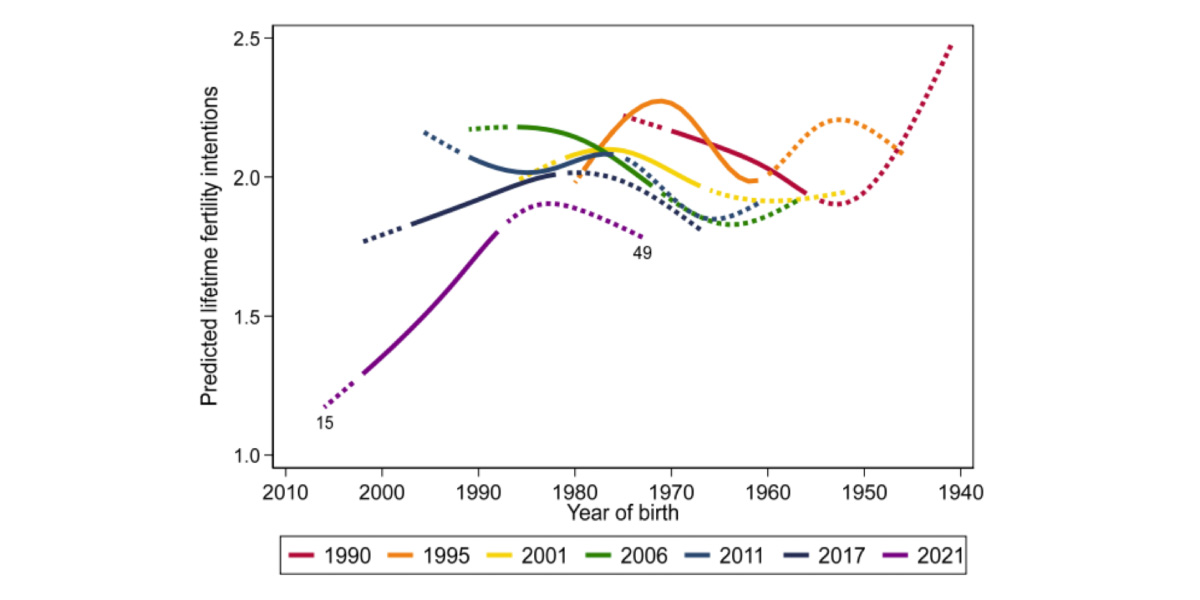
In a recent paper, we examined fertility intentions among Canadian women using seven national surveys conducted between 1990 and 2021 (Laplante and Blouin 2026). Our results show a clear decline over the last three decades, with a particularly marked decrease after 2011 and again after 2017. Today, the average number of children women intend to have over their lifetime is below replacement level (Figure 1).
Figure 1 Lifetime fertility intentions according to year of birth among women aged 15–49 by survey, predicted from a regression in which the effect of age is modelled using a cubic spline.
Source: Statistics Canada, General Social Survey 1990–2017 and Canadian Social Survey 2021.
Note: Read from left to right, each curve represents the variation in lifetime fertility intentions according to age among women aged 15–49 in a given survey. The solid portion of each curve represents women aged 20–34.
The rise of intended childlessness
The most striking finding concerns young women, most of whom, in the early surveys, expected to become mothers. By contrast, in the most recent surveys, close to half of women at the beginning of their reproductive lives reported intentions that imply remaining childless. This does not mean that none of them will ultimately have children, as intentions evolve over the life course. Yet the change is large enough to suggest a profound transformation in the place of parenthood within contemporary adulthood.
Our analysis also shows that fertility intentions follow a life-course pattern. Younger women often revise their intentions as they move through adulthood, form partnerships, complete their education, and have children. More educated women tend to postpone childbearing and therefore express their intentions on a different timetable than less educated women. Nonetheless, across educational groups, the overall trend points in the same direction: intentions are lower than they were a generation ago.
The decline in intentions appears to result from two related developments. First, childless women increasingly report lower intended family sizes. Second, childlessness itself has become more common at all ages, which further reduces average intentions in the population. Together, these two changes help explain why fertility intentions have fallen so substantially.
A puzzle for family policy
These findings raise an important challenge for policymakers. Most discussions of family policy assume that people want children but face barriers that prevent them from achieving their goals. Under this view, governments should reduce those barriers by providing parental leave, affordable childcare, financial support, or more family-friendly workplaces. Such measures remain valuable: they help parents and improve children’s well-being; they may also allow some people to have the children they already want.
But our findings suggest that another process is at work. If intentions themselves are declining, then policies designed solely to help people realise existing family plans may have only limited effects on fertility levels. Put differently, it is much easier to help people achieve a goal than to encourage them to adopt that goal in the first place.
This creates a dilemma that is increasingly visible across high-income countries. Generous family policies can reduce the cost of having children, but they may prove less effective to support fertility when parenthood no longer occupies the same central place in people’s aspirations and life projects.
The Canadian case therefore raises questions that extend well beyond fertility statistics. Why are fewer young adults envisioning parenthood as part of their future? How have changing values, lifestyles, educational trajectories, economic opportunities, and family norms contributed to this shift? And if societies become increasingly concerned about population decline, what kinds of policy responses remain legitimate and effective in a context where reproductive choices are understood as fundamentally voluntary?
These are difficult questions, and our research does not provide all the answers. What it does suggest is that the recent decline in fertility cannot be understood solely as a story of unmet demand for children. It is also a story about changing intentions.
Understanding why that is happening may be one of the most important demographic challenges facing Canada, and possibly also other countries, in the years ahead.
References
Beaujouan, É and Berghammer, C. (2019). The gap between lifetime fertility intentions and completed fertility in Europe and the United States: A cohort approach. Population research and policy review 38(4): 507–535. doi: 10.1007/s11113-019-09516-3
Friedrich, C and Bujard, M. (2025). Intended, ideal, and actual fertility in 11 European countries. Evidence on fertility gaps in different age groups from the Generations and Gender Survey. Wiesbaden: Federal Institute for Population Research (BiB.Working Paper 2/2025).
Hays, J. (2025). U.S. adults in their 20s and 30s plan to have fewer children than in the past. Pew Research Center. https://pewrsr.ch/43Oycpv (retrieved on 10 August 2025).
Hellstrand, J., Nisén, J., Miranda, V., Fallesen, P., Dommermuth, L., and Myrskylä; M. (2021). Not just later, but fewer: Novel trends in cohort fertility in the Nordic countries. Demography 58(4): 1373–1399. doi: 10.1215/00703370-9373618.
Laplante, B. and Blouin, J. (2026). “The recent decline in women’s fertility intentions in Canada: The shift in the intention schedule and the puzzle for family policy.” Demographic Research 55(12): 371–412.
Statistics Canada (2023). Crude birth rate, age-specific fertility rates and total fertility rate (live births), Table: 13-10-0418-01, Release date: 2025-09-24.
Testa, M. R. (2012). Family sizes in Europe. Evidence from the 2011 Eurobarometer survey. Vienna: Vienna Institute of Demography (European Demographic Research Paper n° 2).