Young people in search of family

Letizia Mencarini and Arnstein Aassve present the results of a recent survey on the aspirations of the young worldwide. Contrary to the prevailing current narrative, family formation is still a priority, but the preconditions for parenthood have become increasingly hard to materialize.
Every July 11, World Population Day invites us to reflect on where humanity is heading demographically. The Day was born on the wave of “Five Billion Day” on 11 July 1987, when the world’s population was estimated to have reached five billion people. Today we are 8.3 billion, but the annual growth rate, while still adding some 70‒75 million people a year, has fallen below 1%, in a steady and marked slowdown since the peak of 2.1% reached in the late 1960s. Concern over population explosion has by now been overtaken by concern over the inequality in reproductive behaviour, never so extreme, with a record low of less than one child per woman on average in South Korea and a record high still above six children in the countries of sub-Saharan Africa.
This year’s World Population Day theme was “Realizing the hopes and aspirations of young people – today and for the future”. Across much of the world, a narrative has taken hold: falling fertility simply reflects a shift in values. Young people, the story goes, are turning their backs on family life, favouring career, independence and freedom. This is a sensible-sounding explanation but it is also, in large part, wrong.
A worldwide survey on the aspirations of the young
Early in July, the United Nations Population Fund launched its Demographic Futures Survey (UNFPA 2026) one of the largest demographic surveys ever conducted, drawing on responses from 108,926 Internet-connected young people aged 18 to 39 across 73 countries and territories. The data were weighted by sex, age and educational attainment: although not statistically representative of national populations, they offer an unprecedented comparative view of the aspirations, perceptions and experiences of young people living in very different economic, social and institutional contexts.
What the data reveal is not a generation that has given up on family, but a generation that wants a family and cannot build one. Economic security and being fit and healthy are, tellingly, the life goals rated as most important overall, cited as such by about 90% of respondents – well ahead of career or personal fulfilment. The findings are consistent across every region, from sub-Saharan Africa to Western Europe, from Latin America to East Asia. Economic security and stable housing top the list of what young people say they need before forming a partnership or having children. Financial security, in particular, is the single most cited consideration for forming a partnership, rated important by 81% of respondents; and economic and housing constraints are, at 57%, the most commonly reported barrier at this stage of life. More than two thirds see marriage, or a stable relationship, as part of their ideal future: 36% before living together, 34% after a period of cohabitation. Yet one in four of those aged 25 to 39 who want a partner (30% of men, 19% of women) are currently single and not even dating.
What explains this gap? The survey points to a structural logic that repeats itself across very different contexts. Young people describe a precise sequence of preconditions for adult life: stable employment first, then independent housing, then partnership, then children. When the first link breaks – and for many it breaks easily – every subsequent milestone is left suspended.
Parenthood? Yes, given certain conditions
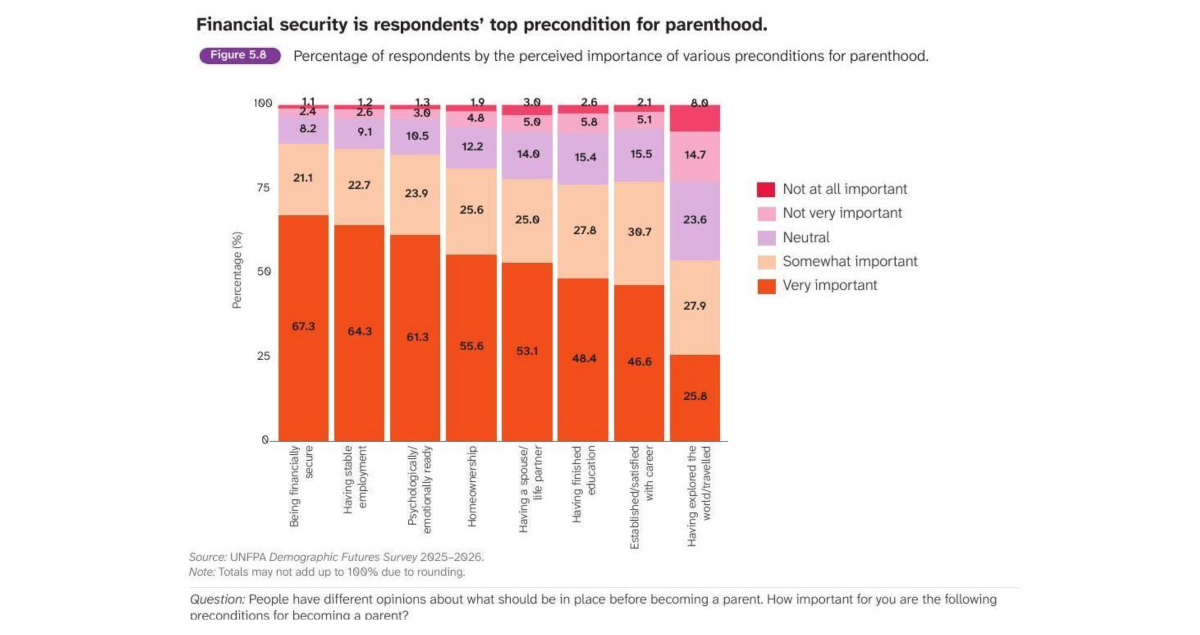
The picture is even sharper when it comes specifically to parenthood. Financial security is by far the most cited precondition for feeling ready to have children: 88% of respondents consider it important, and fully 67% rate it “very important” (Figure 1). Close behind comes stable employment (87%, 64% “very important”) and psychological and emotional readiness (85%). Owning a home and having a stable partner also weigh heavily in the decision, more than personal fulfilment or educational attainment. At the same time, economic and housing constraints are also the leading barrier to parenthood, cited by 72% of respondents, more than lack of a suitable partner or reproductive health issues.
Figure 1 – Perceived importance of various preconditions for parenthood (% of respondents).
Source: UNFPA (2026).
This is not a generation that has stopped wanting a family: it is a generation waiting for conditions that are not arriving. An often-overlooked figure makes the point: among childless 35-39-year-olds in Western Europe, Australia, Canada and the United States, the large majority say they still want children: 73% of men and 62% of women. Time to fulfil that wish, biologically and socially, is running out, however.
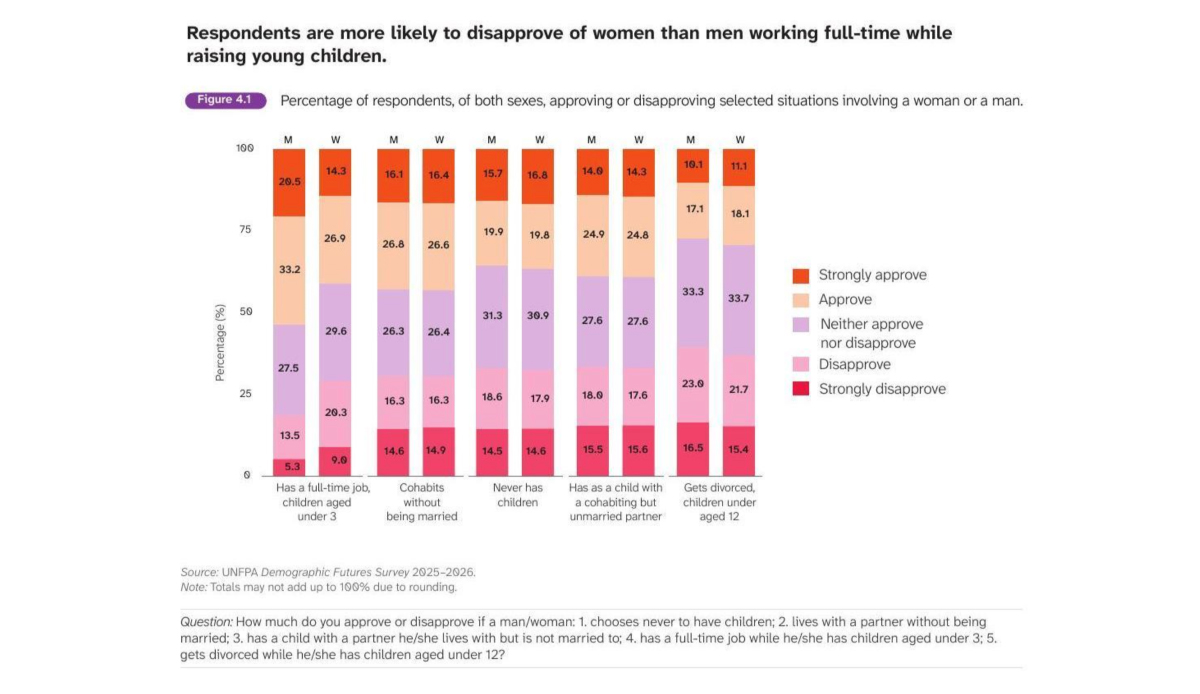
The gender dimension is equally important. Globally, 29% of respondents disapprove of a woman holding a full-time job while her children are under three, against just 20% who disapprove of a father doing the same, the widest gender gap among all the family situations tested by the survey (Figure 2). Young women, as a result, rate every precondition for parenthood as more important than young men do, not because they want fewer children, but because they correctly anticipate bearing more of the care burden. Where parenthood demands more from women than from men, women’s aspirations are more likely to go unrealized. This very anticipation becomes a driver of reproductive behaviour, delaying family formation and reducing family size.
Figure 2 – Approval or disapproval of selected family situations involving a woman or a man (% of respondents)
Source: UNFPA, Demographic Futures Survey 2025-2026.
Optimism about the future follows the same geography of opportunity: 62% of young people in West and Central Africa describe themselves as “very positive” about their future, against just 19% of their peers in Western Europe, Australia, Canada and the United States, the very countries where, paradoxically, material conditions are on average better, but where the perceived cost of starting a family is higher relative to the resources available.
Implications for public policy
The implications for public policy are clear. Governments around the world have responded to the “demographic anxiety” over fertility falling well below the replacement level (just above two children per woman) mainly with one-off financial incentives such as baby bonuses, tax breaks and direct transfers. These are interventions at the wrong stage of life: they act more on child-rearing than on the decision to have children, leaving untouched the conditions that must first be met. Affordable housing, job security, accessible public childcare, a genuine sharing of care work between partners: these are the broken links. Until they are repaired, cash transfers to families with children will shift, and only slightly, the number and timing of births, without changing what young people are able to achieve in the early stages of their adult lives. It is no accident that the UNFPA report explicitly frames these conclusions within a rights-based approach to demographic policy, one that gives priority to people’s agency rather than population targets pursued through incentives or pressure.
On the 2026 World Population Day, the UNFPA survey sends a clear message: young people have not abandoned their aspirations and hopes of building a family. They do not need lectures on “demographic duty”. They need the conditions that make the life they already want actually possible.
References
UNFPA (2026) Lives, Choices and Futures: What Young People Want and What Shapes their Decisions about Relationships and Parenthood – Findings from the Demographic Futures Survey 2026. Research report: United Nations Population Fund, 2026. New York: UNFPA.
https://www.unfpa.org/sites/default/files/pub-pdf/Lives-choices-and-futures.pdf
The authors of this publication are Priscilla Idele, Elizabeth Wilkins and Alessio Cangiano of UNFPA and a group researchers from Bocconi University coordinated by Arnstein Aassve including Elisa Latora and Luca Di Casola as co-authors and Letizia Mencarini, Chen Peng and Samuel Plach as participants to the survey and research design.