Too old to give blood? Not in South Korea

As populations age across East Asia, blood banks face a double squeeze: fewer young donors and more elderly patients needing transfusions. South Korea, Oh Seok Kim notes, has promptly responded by raising its blood donation age cap. Other nations will soon have to follow its example.
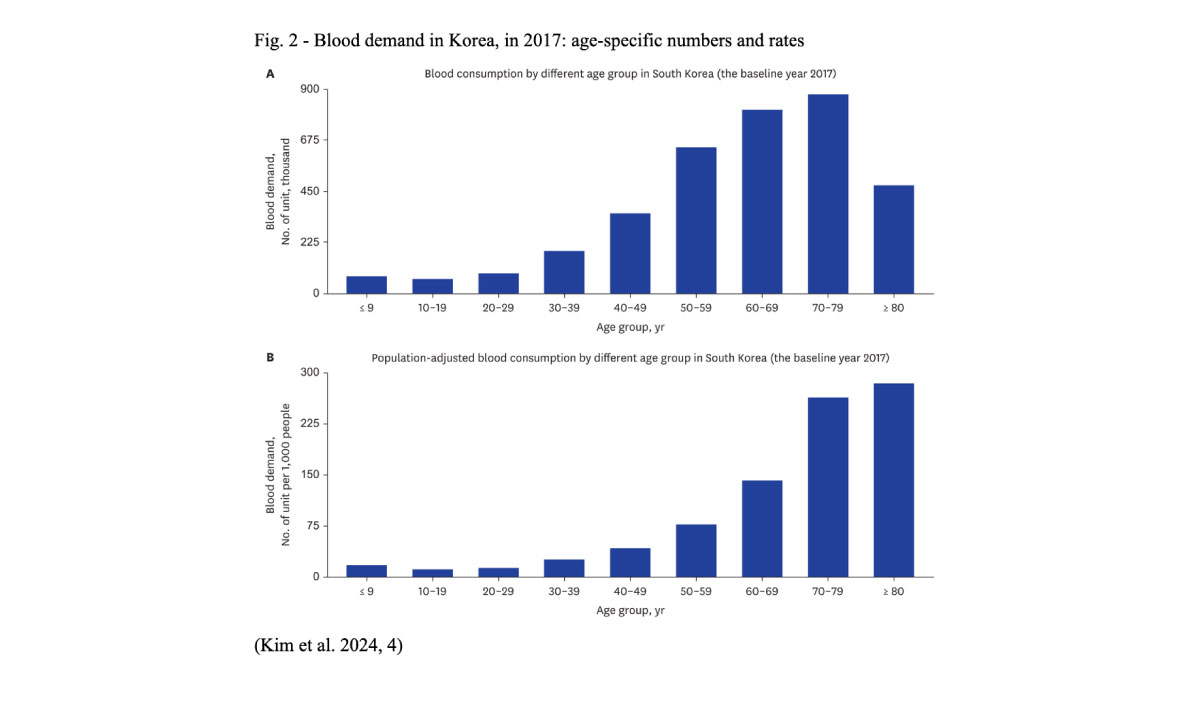
Every time a patient goes into surgery, gives birth, or battles cancer, there is a good chance they will need someone else’s blood. Blood donors in South Korea are overwhelmingly in their teens, twenties, and thirties; blood recipients, instead, are typically in their seventies and eighties – and increasingly so, given population aging. The arithmetic, replicated country by country across East Asia, is unforgiving. Admittedly, this is just another example of the possible imbalances caused by population aging; however, its nature and the emotional impact of the topic seem to make it worth special consideration.
The arithmetic of aging and blood
Yu et al. (2020) were among the first to model what may happen to blood supply and demand in China between 2017 and 2036, as the country ages. Supply is projected to fall by 16 per cent while demand will rise by 33 per cent, leaving a potential shortfall of 21.2 million units by 2036, equivalent to more than a third of projected annual demand (a unit is approximately 450 ml, or a pint). The driving mechanism is straightforward: fewer people in the peak donating ages of 18–34, and far more in the heavy-transfusion-using ages of 70 and above, where blood use per person runs more than 25 times higher than among teenagers.
Not surprisingly, the same trend can be observed also in other countries. In Taiwan, for instance, the pool of eligible blood donors, people aged 17 to 65, is expected to shrink from 16 million in 2025 to just 8.7 million by 2060. Blood demand is projected to exceed supply by around 2027, with the annual shortfall surpassing one million units by 2060 (Lin et al. 2026).
The Korean case
A similar problem will emerge in South Korea, one of the world’s fastest-aging societies (Kim and Kim 2020). In 2024, Korea’s blood donation rate (number of donations per 100 people) stood at 5.6% (Korean Redcross Blood Services 2025): higher than Japan’s 4.0% or France’s 3.9%, and among the highest globally. But that headline figure conceals a structural fragility: more than half of all donations come from people aged 16 to 29, a cohort shrinking rapidly as the country’s birth rate, already the world’s lowest, continues to fall (Figure 1).
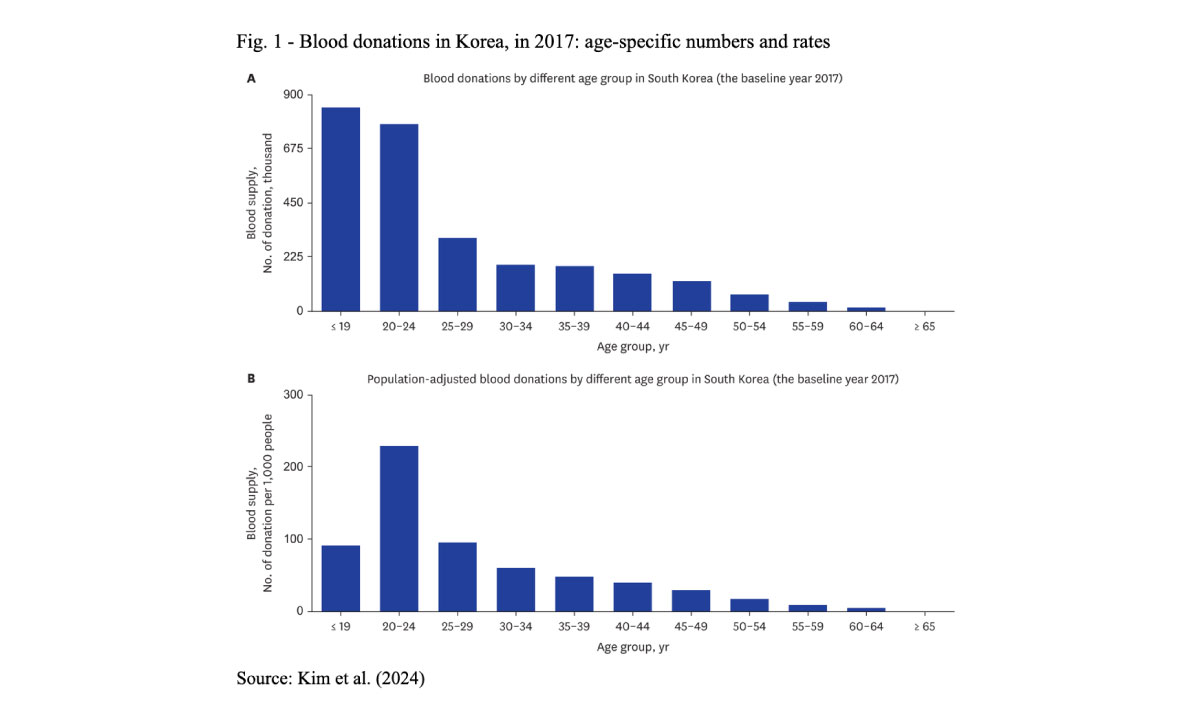
At the same time, elderly patients, who consume the most blood per person, are growing in number at a pace few health systems have had to manage before (Kim et al. 2024).
From research to legislation
On 13 May 2026, South Korea’s Ministry of Health and Welfare announced the country’s Second Blood Management Basic Plan, covering 2026 to 2030. It is the most significant revision of blood donation rules in a decade.
The centerpiece is an increase in the upper age limit for blood donation. Currently, whole-blood donation is permitted up to the age of 69, and, for people aged 65 to 69, only if they donated between the ages of 60 and 64. Under the new plan, that ceiling may rise by even more than five years, as officials have not ruled out scrapping the age limit altogether, replacing it with an individual health assessment.
A second change abolishes a long-running chemical test on donated blood: the alanine aminotransferase test (ALT), which measures a liver enzyme. Introduced in the 1990s to guard against hepatitis, it was overtaken by more precise direct virus-detection methods but survived as a bureaucratic habit. Between 2020 and 2025, roughly 33% of donated blood (170 thousand units) was discarded because of ALT results alone, enough to fill hundreds of thousands of standard transfusion bags. That waste will now stop.
The plan also proposes practical incentives: streaming-service subscriptions as gifts for young donors, and regular blood donation buses in areas with no permanent blood bank.
The safety case for expanding the donor age is well supported. Older donors in good health produce blood that is as safe as that of younger donors, and several European countries, such as the UK and Italy, already permit donations beyond 65 under specific conditions (National Health Service (NHS) Blood and Transplant 2026; Ministero della Salute e Centro Nazionale Sangue 2026). The practical question is whether enough healthy older adults will come forward to make a meaningful difference. Korea’s experiment is likely to be watched closely.
From science to policy
Blood supply is also a demographic problem. Typically, donor eligibility rules were written for a young population, who also kept transfusion demand relatively low, and the system was in balance. But the world is rapidly changing: the sooner countries acknowledge the mismatch, and change their rules accordingly, the better placed they will be to keep their hospitals running.
The change in Korean law is a rare, clear example of research shaping policy, and quickly. Other aging societies would do well to read the evidence before the blood runs short.
References
Yu X et al. Population-based projections of blood supply and demand, China, 2017–2036. Bulletin of the World Health Organization, 2020;98(1):10–18. doi:10.2471/BLT.19.233361
Kim KW and Kim OS. Super aging in South Korea unstoppable but mitigatable: A sub-national scale population projection for best policy planning. Spatial Demography, 2020; 8:155–173. doi: 10.1007/s40980-020-00061-8
Kim OS et al. Future blood debt: projecting blood supply and demand of Korea based on subnational population projections (2021–2050). Journal of Korean Medical Science, 2024;39:e168. doi:10.3346/jkms.2024.39.e168
Lin Y-M et al. Forecasting blood supply and demand under population aging: implications and challenges for healthcare resource allocation. BMC Health Services Research, 2026;26:369. doi:10.1186/s12913-026-14150-9
Ministero della Salute e Centro Nazionale Sangue. Accessed 15 June 2026. (In Italian) https://www.donailsangue.salute.gov.it/it/sangue-pagina/chi-puo-donare/
National Health Service (NHS) Blood and Transplant. Accessed 15 June 2026. https://www.blood.co.uk/who-can-give-blood/
Korean Ministry of Health and Welfare. Second Blood Management Basic Plan 2026–2030. Announced 13 May 2026. (In Korean) https://www.mohw.go.kr/board.es?mid=a10503010100&bid=0027&act=view&list_no=1490506&tag=&nPage=1
Korean Redcross Blood Services. Blood Services Statistical Yearbook 2025. (In Korean) https://www.bloodinfo.net/knrcbs/na/ntt/selectNttList.do?mi=1158&bbsId=1061&nttSn=548750