


With increasing life expectancy, people are expected to work longer, but longer working lives are not inherently healthier. By estimating the years people spend working with chronic disease, Anastasia Lam and colleagues highlight that inequalities in who works longer and in good health are largely shaped by gender and urban-rural residence in South Korea.
In countries where informal labour markets are widespread and public pensions fall short, stopping work at retirement age may not be an option. South Korea has among the highest life expectancies (83.5 years) and the highest rate of old-age employment among OECD countries; 57 per cent of 65–69-year-olds were employed in 2024 (OECD, 2025). But living and working longer doesn’t mean these extra years are spent in good health. This raises an important question: are people healthy enough to extend their working lives, or are they working longer despite poor health?
Pensions in South Korea
In South Korea the pension age is currently 63 years, expected to rise to 65 by 2033, but pension system covers fewer than half of older adults, which contributes to old-age poverty being among the highest in the OECD (OECD, 2018). As a result, many people need to work well into old age, whether to bridge the gap between retirement and pension, or to supplement the basic pension they do receive.
In a recent study (Lam et al., 2026), we estimated not just how long older South Koreans work, but how much of that time is spent with chronic disease, and looked for differences by gender, education, or urban-rural residence. We defined health using a count of nine chronic conditions, grouped into no disease, one disease, and two or more diseases (multimorbidity). By treating health as a gradient, rather than simply healthy and unhealthy, we get a fuller picture of the ageing process.
Who works longer, and in what state of health?
Three findings stand out. First, men work far longer than women. From age 50 they can expect to work for a further 16.9 years, compared to 9.9 for women (Figure 1). For both men and women, nearly half of those working years are lived with at least one chronic disease. This gender difference in working life expectancy reflects longstanding inequalities in the labour market. Women’s working lives have long been defined by highly gendered norms around labour force participation and caregiving roles, leading women to have more accumulated disadvantages across their life course (Brinton & Oh, 2019). Conversely, men are more likely to face social pressure to continue as the family’s main provider and often stay more strongly attached to work (Lee & Yeung, 2021).
Figure 1. Weighted life expectancy from age 50 split by time spent in each state: Men and women, South Korea, 2006–22.
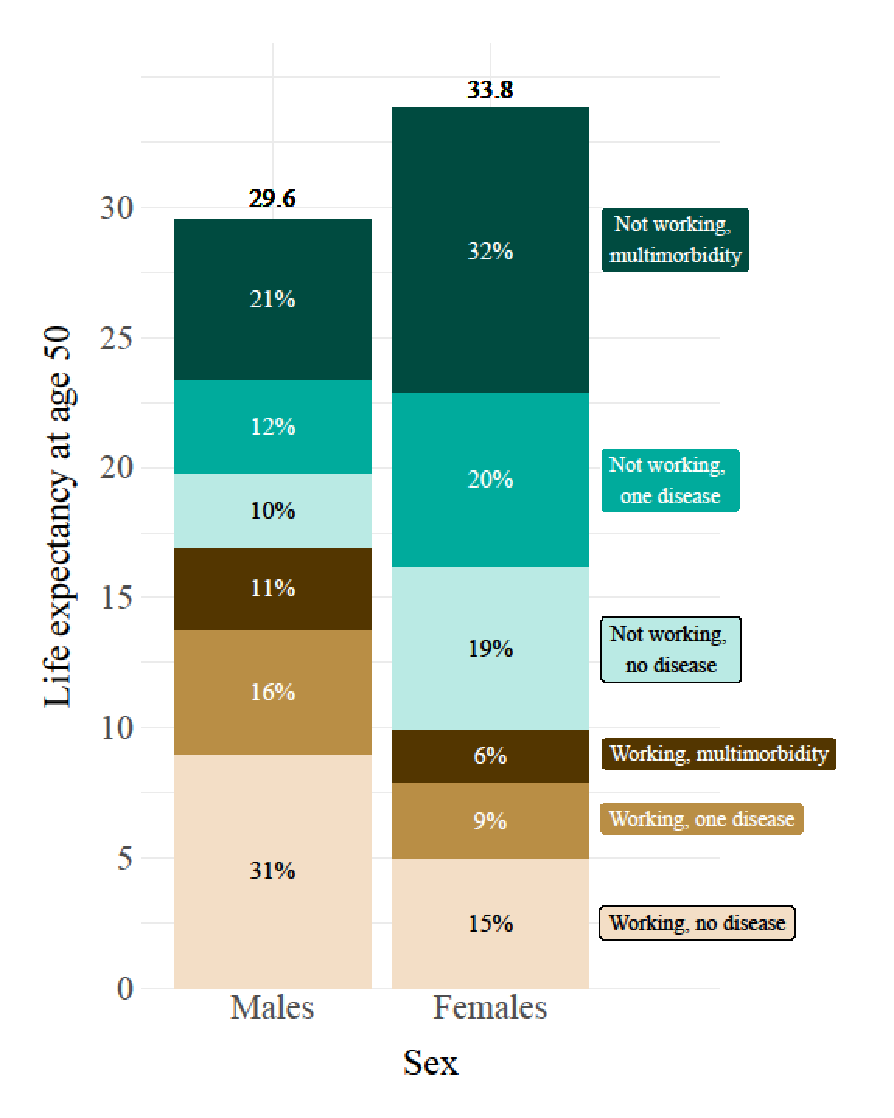
Note: Coloured bars display the percentages of remaining life expectancy in each state; total weighted life expectancy in years is displayed at the top of each bar.
Source: Lam et al. (2026)
Second, educational differences were minimal. However, people with less education may work longer than those with more education, in line with another study from South Korea (Yang et al., 2025), but contrary to what is usually seen in the United States and Europe (Feraldi & Dudel, 2025; Sperlich et al., 2023).
Third, where people live seems to matter more than their education. Men living in rural areas work longer than any other group, more than four years longer than urban men, and keep working until around age 70 on average (Figure 2). They also spend about half their working lives with at least one chronic disease, and have more multimorbidity than men from urban areas. The same pattern of urban-rural inequality can be seen for women, with those living in rural areas working about six years beyond retirement age compared to urban dwelling women who withdraw from the labour market even before retirement age.
Figure 2. Weighted life expectancy from age 50 split by time spent in each state, men and women in South Korea, 2006–22, by place of residence.
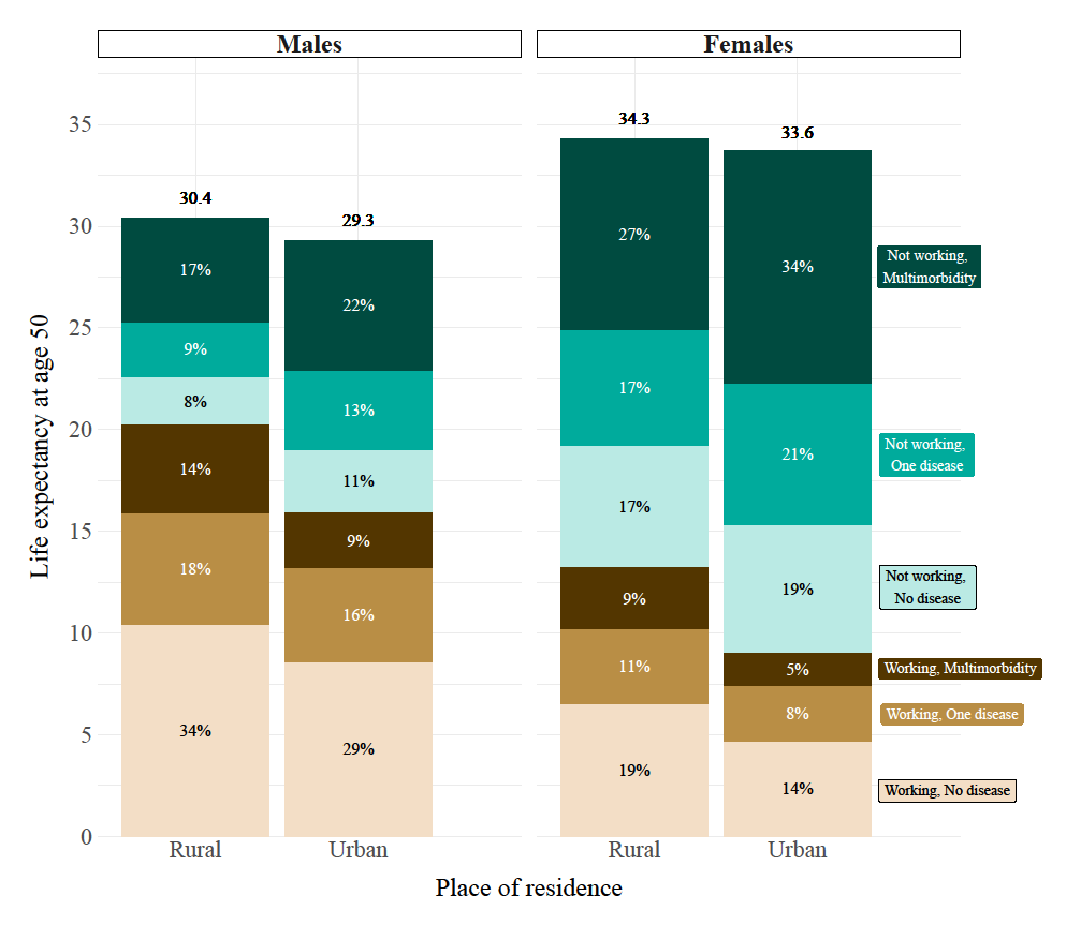
Note: Coloured bars display the percentages of remaining life expectancy in each state; total weighted life expectancy in years is displayed at the top of each bar.
Source: Lam et al. (2026)
While our study did not directly examine what might be driving the longer, unhealthier working life expectancy among people in rural areas, we expect it to be related to the structure of employment in rural areas and the history of rural-urban migration, compounded by unequal access to healthcare. Older adults living in rural areas are more often self-employed or working in agriculture, jobs less subject to mandatory retirement and rarely tied to an adequate pension. As younger generations migrated to cities for more education and work opportunities, the older generation who remained kept working, but whether through choice or necessity is unclear.
Beyond “longer is healthier”
Our findings caution against assuming that longer working lives are inherently healthier, and that the findings from one context can be generalized to another. In South Korea, the people working longest are not always the most advantaged or the healthiest: those living in rural areas, and to a lesser extent those with low education, spend more time working despite poorer health compared to their urban and highly educated counterparts.
This matters for policies that encourage extended working lives. The capacity to work longer, and to do so in good health, is not shared equally: it depends on gender, place of residence, and the institutional and social context people live in.
For South Korea, that points to a need for policies that ease the pressure to work despite poor health, including better pension coverage for self-employed and informal workers and improved preventive care and healthcare access in rural areas. Behind South Korea’s high rates of old-age employment lies a gendered and geographic division of labour, one that decides not just who works longest, but who does so in poor health.
References
Brinton, M. C., & Oh, E. (2019). Babies, Work, or Both? Highly Educated Women’s Employment and Fertility in East Asia. American Journal of Sociology, 125(1), 105–140. https://doi.org/10.1086/704369
Feraldi, A., & Dudel, C. (2025). Healthy Working Life Expectancy: Measurements and Socio-Economic Inequalities. In E. di Bella, V. Gioia, C. Lagazio, & S. Zaccarin (Eds.), Statistics for Innovation III (pp. 213–218). Springer Nature Switzerland. https://doi.org/10.1007/978-3-031-95995-0_36
Lam, A., Keenan, K., Kulu, H., & Myrskylä, M. (2026). Working longer despite poorer health? Inequalities in healthy and unhealthy working life expectancies in South Korea. Population Studies, 1–18. https://doi.org/10.1080/00324728.2026.2625712
Lee, Y., & Yeung, W.-J. J. (2021). The Country That Never Retires: The Gendered Pathways to Retirement in South Korea. The Journals of Gerontology: Series B, 76(3), 642–655. https://doi.org/10.1093/geronb/gbaa016
OECD. (2018). Working Better with Age: Korea. https://doi.org/10.1787/9789264208261-en
OECD. (2025). Pensions at a Glance 2025: OECD and G20 Indicators. OECD Publishing. https://doi.org/10.1787/e40274c1-en
Sperlich, S., Beller, J., Epping, J., Geyer, S., & Tetzlaff, J. (2023). Trends of healthy and unhealthy working life expectancy in Germany between 2001 and 2020 at ages 50 and 60: A question of educational level? J Epidemiol Community Health, 77(7), 430–439. https://doi.org/10.1136/jech-2023-220345
Yang, M., Lee, J., Lynch, M., Wilkie, R., Tongeren, M. van, & Kang, M.-Y. (2025). Educational and gender disparities in healthy working life expectancy among middle-aged and older adults in South Korea. Occupational and Environmental Medicine, 82(6), 293–299. https://doi.org/10.1136/oemed-2025-110239