


Becoming a parent during doctoral training carries lasting career consequences, but not equally for women and men. Xinyi Zhao presents the results of a global study on 8,097 academic parents and shows that early parenthood significantly reduces women’s PhD completion rates, citation impact, and academic job retention, while leaving men’s trajectories largely unaffected.
Doctoral training now coincides more than ever with women’s prime reproductive years. In the United States in 1992, the median age at PhD completion was 36 for women and 33 for men. By 2022, both had converged to around 32. This convergence is a sign of progress, but it comes with an underappreciated cost: doctoral training now falls squarely within women’s prime reproductive years. Across many countries, the same window in which researchers are expected to publish, network, and build their reputations is also the window in which family formation typically occurs. For decades, the conventional wisdom told women to delay childbearing until after tenure (Mason, Wolfinger, and Goulden, 2013).
In a recent study (Zhao et al., 2026), we used a global survey of 8,097 academic parents, linked to their actual publication records over time, to reconstruct how researchers juggle doctoral training and parenthood. Our results reveal striking gender asymmetries that begin during doctoral training and continue throughout academic careers.
Five paths, unequally distributed
In the study, we identified five distinct life-course trajectories based on the timing and sequencing of PhD completion and first parenthood. The most common one, followed by 28% of the sample, was completing the PhD early (before 30) but delaying parenthood until after 35. This pattern is particularly common among women born after 1970, consistent with a broader trend of later family formation among highly educated women.
Men, by contrast, were significantly more likely to fall into the trajectory involving early parenthood alongside doctoral training, becoming fathers before age 30 while also completing a PhD, and tending to have larger families. This trajectory was the smallest in the sample (under 10%) but showed the sharpest gender imbalance, and that imbalance has widened over successive birth cohorts.
The share of publishing researchers without a doctorate by age 40, a trajectory strongly associated with women, has declined dramatically over time, reflecting real progress in closing the doctoral gender gap. But progress at the entry level has not translated into equality in outcomes.
Parenthood penalises mothers, not fathers: what can institutions do?
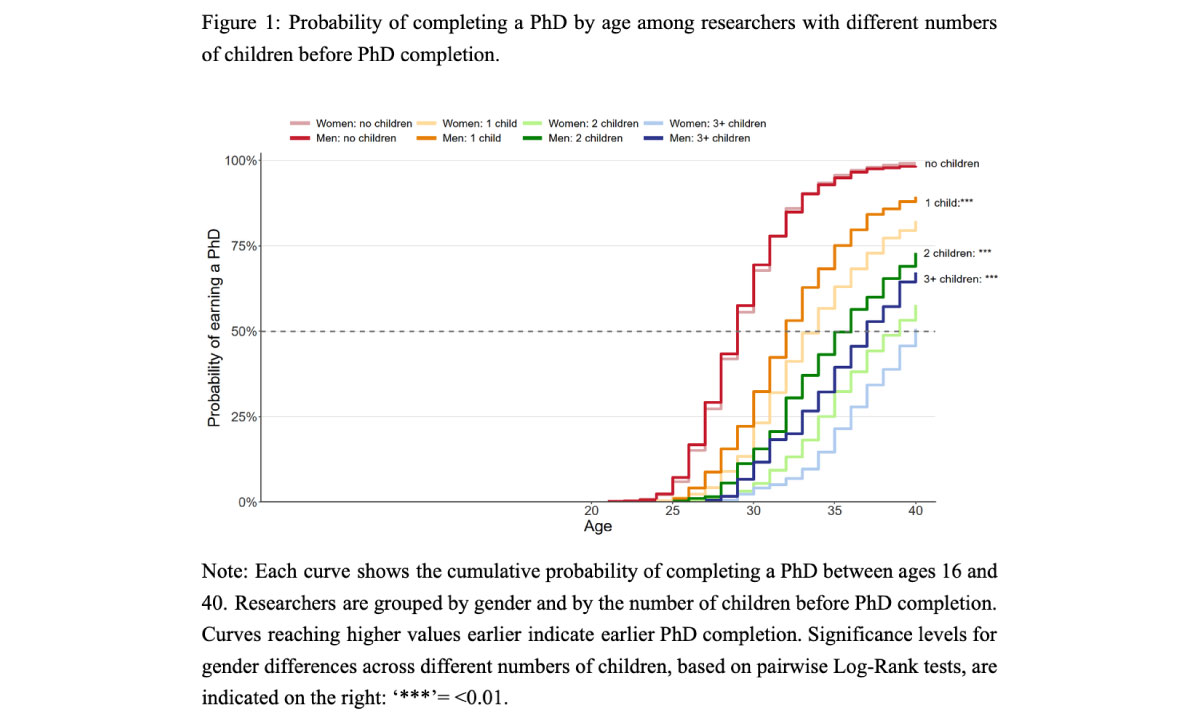
The consequences of these different life-course trajectories become clear when we examine doctoral completion. Figure 1 shows the probability of completing a PhD by age according to gender and the number of children before PhD completion. Among researchers without children, women and men completed PhDs at almost identical rates. Researchers who had children before completing their PhD were substantially less likely to earn a doctorate than those without children, with women experiencing consistently larger disadvantages than men with the same number of children. The divergence between women’s and men’s PhD completion trajectories grew larger as the number of children increased.
The timing of parenthood also shapes long-term scientific impact. Women’s citation impact declined progressively as parenthood occurred earlier in their careers. Those who had their first child before age 30 experienced the largest citation disadvantage relative to men, whereas women who delayed parenthood until after age 35 achieved citation impact comparable to their male peers. Men showed no comparable pattern regardless of when they became fathers; their scientific impact remained largely unchanged. This mirrors what Morgan et al. (2021) described as a “fatherhood premium” in academia: becoming a parent tends to support men’s upward career trajectories while constraining women’s.
The same pattern is evident in career retention. Men were consistently more likely than women to remain in academic positions across all five identified trajectories, with the largest gender differences (7–9 percentage points) among those who completed their PhD early and became parents thereafter.
These findings challenge explanations of women’s underrepresentation in science that focus on ability or preferences. Among researchers without children, there is little evidence of a gender gap. The gap emerges and widens when caregiving responsibilities collide with the demands of doctoral training and early academic careers.
The implications are structural rather than prescriptive. Parental leave for PhD students remains inconsistently available and poorly formalised at many universities. Tenure and fellowship clocks rarely account for caregiving-related disruptions. Evaluation criteria implicitly reward uninterrupted productivity, disadvantaging those who take career breaks. Nordic countries offer a useful benchmark: their more generous leave provisions are associated with less severe career interruptions, though generous leave alone does not neutralise the pressure to maintain continuous output. The deeper issue is not that women make the wrong choice about when to have children, but that the academic timeline itself forces a choice in the first place.
Changing that requires more than isolated accommodations. Childcare provision for doctoral students, structured mentoring for parenting researchers, re-entry funding after career breaks, and reforms to how research performance is evaluated are not simply matters of fairness; they are also matters of scientific efficiency: the persistent loss of talented researchers at the doctoral stage represents a cost to the research enterprise as a whole.
References
Mason, M. A., Wolfinger, N. H., and Goulden, M. (2013). Do Babies Matter? Gender and Family in the Ivory Tower. Rutgers University Press.
Morgan, A. C., Way, S. F., Hoefer, M. J. D., Larremore, D. B., Galesic, M., and Clauset, A. (2021). The unequal impact of parenthood in academia. Science Advances, 7(9). https://doi.org/10.1126/sciadv.abd1996
Zhao, X., Derrick, G. E., Sugimoto, C. R., & Larivière, V. (2026). Starting a PhD and becoming a parent: Gendered life-course trajectories in academic careers. Higher Education. https://doi.org/10.1007/s10734-026-01668-4