


Many Japanese couples have fewer children than they consider ideal. Ester Lazzari, Shohei Yoda, Setsuya Fukuda and James Raymo show that infecundity is becoming an increasingly important reason for this shortfall. Medically assisted reproduction helps close the gap between ideal and achieved family size, but access to treatment remains unequal.
Across low-fertility countries, many people reach the end of their reproductive years with fewer children than they ideally wanted (Lazzari and Beaujouan 2026). Research on low fertility has traditionally emphasized social and economic constraints, such as the costs of raising children, difficulties combining employment and family life, and obstacles to partnership formation. However, much less attention has been paid to infecundity as a factor limiting the realization of fertility ideals.
Japan provides a particularly relevant case in which to examine this issue. There has long been a persistent gap between the number of children married couples consider ideal and the number they ultimately have (Figure 1).
Figure 1. Ideal and achieved family size among married Japanese women aged 40-49, 1977-2021.
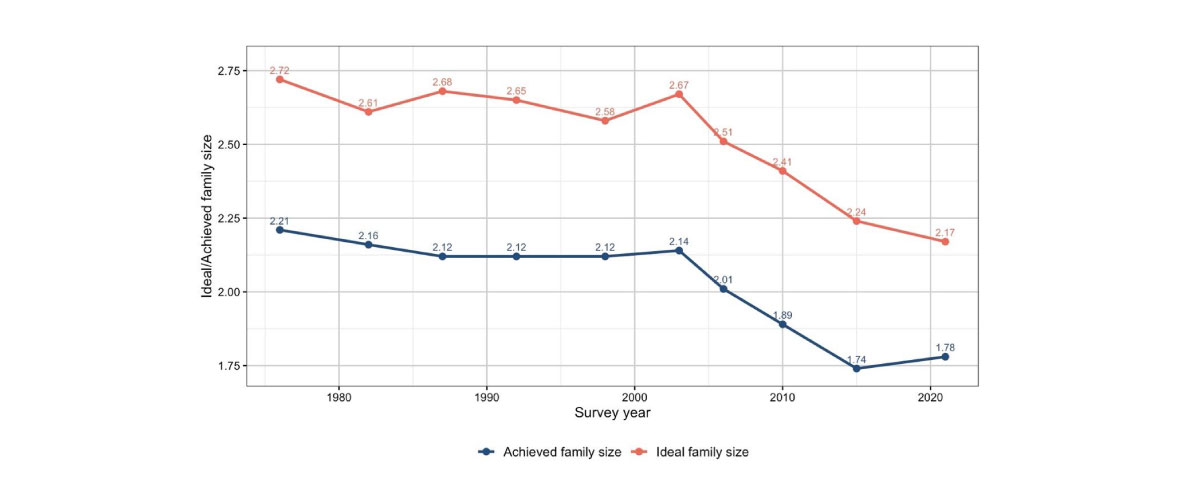
Note: Based on 32,577 married women aged 40-49. Data: Japanese National Fertility Survey, 1977-2021.
At the same time, marriage and childbearing have shifted to progressively older ages. Because childbearing in Japan occurs overwhelmingly within marriage, later marriage also tends to mean a later start to family formation. Medically assisted reproduction (MAR) has consequently become increasingly important, with around one in ten births in Japan resulting from assisted reproductive technology in 2022.
In a recent article (Lazzari et al. 2026), we asked how important infecundity is in limiting married couples’ ability to reach their ideal family size, how much MAR helps close the gap between ideal and achieved family size, and whether these patterns differ by educational attainment and age at marriage. To answer these questions, we drew on five rounds of the Japanese National Fertility Survey conducted between 2002 and 2021, covering almost 14,000 married women aged 40–49.
Delayed marriage and rising infecundity concerns
In 2002, 24% of married women aged 40–49 reported that they had at some point worried about their ability to conceive. By 2021, this figure had increased to 39%. This increase occurred alongside postponement of marriage. Among currently married women in our sample, the average age at marriage rose from 25.9 years in 2002 to 28.9 years in 2021. University-educated women consistently married later than women with lower levels of education.
The most commonly reported reason for having fewer children than the ideal number was the financial cost of raising and educating children, mentioned by 44% of married women in 2021. Concerns about age were also widespread, with almost half reporting that they did not want to have a child at an older age. Difficulties conceiving, however, became increasingly prominent. Among women who did not expect to reach their ideal family size, the proportion saying that this was because they “cannot conceive even though [they] want children” increased from 19% in 2002 to 29% in 2021. Notably, this was the only reported barrier to show a clear upward trend over time.
This barrier was particularly evident among women who married later. Women who married at age 35 or older were more likely than those who married earlier to cite infecundity as a reason for falling short of their ideal family size. They were also more likely to say that they did not want to give birth at an older age. Postponement can therefore constrain fertility in two related ways: couples may encounter declining reproductive capacity by the time they try to have children, while at the same time becoming less willing to continue childbearing at older ages.
The contribution and limits of assisted reproduction
We compared women’s achieved family size with a simple counterfactual measure that excludes births reported as conceived through MAR. This gives an indication of how much larger the gap between ideal and achieved family size might have been in its absence. Overall, MAR-conceived births reduced this gap by roughly one third. However, the contribution of MAR differed substantially across educational groups. In 2021, MAR reduced the gap by 42% among university-educated women, compared with 33% among women with junior college or vocational education and 24% among those with a high-school education or less.
Figure 2. Ideal and achieved family size among married Japanese women aged 40–49, with and without MAR, by educational attainment, 2015 (top row) and 2021 (bottom row)
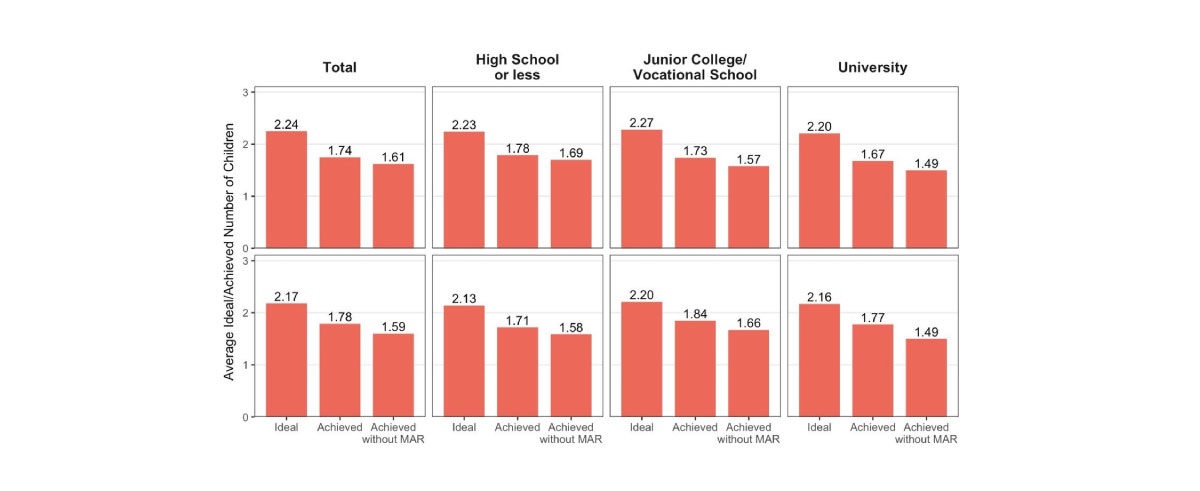
Note: Based on 5,954 married women aged 40–49. Family size without MAR excludes births reported as conceived through MAR. Data: Japanese National Fertility Survey, 2015-2021.
These differences appear to arise mainly from unequal access to treatment. University-educated women who had experienced concerns about infecundity were more likely to report having undergone MAR than women with lower levels of educational attainment, even after accounting for age at marriage and husbands’ educational attainment. Once women received treatment, however, educational differences in the likelihood of reporting a MAR-conceived child were no longer statistically significant. This suggests that inequality emerges primarily in access to treatment rather than in outcomes among those who receive it. Timing also mattered. Women who married later were substantially less likely to report having had a child following MAR.
Conclusion
The Japanese case illustrates a broader challenge facing many low-fertility societies. As family formation shifts to older ages, the gap between the number of children people want and the number they ultimately have is shaped not only by socioeconomic constraints, but increasingly also by whether people are still biologically able to have children when they try.
Age-related infecundity is itself partly a downstream consequence of the social and economic conditions that lead people to postpone marriage and parenthood. High housing and education costs, difficulties combining employment and family life, and obstacles to finding a partner can all push family formation to later ages. Declining reproductive capacity can then compound these existing constraints, making it more difficult for people to realize their fertility ideals. As MAR becomes increasingly important in helping couples overcome some of these biological constraints, inequalities in access to treatment may also translate into inequalities in the ability to achieve desired family size. Public policy therefore has an important role to play. Japan has progressively expanded financial support for MAR, and since April 2022 many treatments have been covered by National Health Insurance (Inui 2022). Broader coverage may help reduce socioeconomic inequalities in access to MAR and, in turn, promote greater equality in people’s chances of realizing their fertility goals in the future as family formation continues to shift to later ages.
Acknowledgments
This research was supported by funding from the Japan Society for the Promotion of Science (KAKENHI grant JP25K05533) and by the European Research Council under the European Union’s Horizon 2020 research and innovation program (grant agreement 101001410).
References
Inui, M. (2022, March 1). What is the current state of infertility treatment in Japan? The number of specific infertility treatment cases has remained almost flat in recent years. Pregnancy rates decline from age 34, and miscarriage rates increase from age 37 under the conventional subsidy program (Report). NLI Research Institute. Retrieved from https://www.nli-research.co.jp/report/detail/id=70374?site=nli (in Japanese)
Lazzari, E., & Beaujouan, E. (2026). Infertility and unrealized ideal family size. Population and Development Review, 52: 70–93. https://doi.org/10.1111/padr.70043
Lazzari, E., Yoda, S., Fukuda, S., & Raymo, J. (2026). Research Note on the Role of Infertility and Medically Assisted Reproduction on the Realization of Ideal Family Size in Japan. Demography, 12714998. https://doi.org/10.1215/00703370-12714998