


China’s fertility decline has attracted attention. However, total fertility rates are distorted by tempo effects. Tian Wang and Quanbao Jiang use cohort analysis to show that the decline is mainly driven by reduced first-birth progression. Shifts in women’s urban–rural and educational composition also play an increasingly important role.
Annual births in China have dropped dramatically, from 12 million in 2020 to less than 8 million in 2025, and the total fertility rate (TFR) declined from 1.3 in 2020 to probably less than 1.0 in 2025. These figures have attracted considerable scholarly and policy attention. However, period TFRs are biased by tempo effects and may not accurately reflect the “true” fertility level: a cohort perspective may complement the analysis. In a recent study (Wang and Jiang 2026), we used 2017 China Fertility Survey data to calculate age-specific childlessness proportions and the number of children ever born (CEB) by cohort, and we decomposed the changes in CEB to assess how age-parity-specific progression ratios, urban–rural composition, and educational structure contribute to cohort fertility differences.
Fertility has declined across successive cohorts
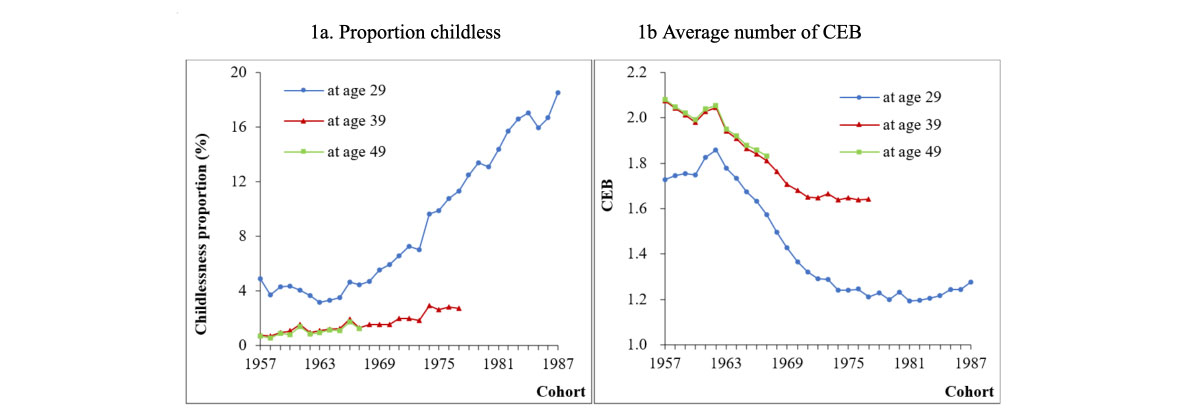
Fertility has declined substantially across successive cohorts of Chinese women. As Figure 1 shows, the childlessness proportion at some illustrative ages (29, 39, and 49 years) has increased while the average number of CEB has declined. The increase in childlessness at younger ages does not necessarily mean that these women will remain childless for life, since some may still have a first child at later reproductive ages. But the recuperation has been insufficient to offset the postponement. Besides, permanent childlessness has notably increased among Chinese women, reflecting both rising infertility and behavioral changes such as delayed marriage and reduced desired family size.
The decline in cohort fertility has not been uniform. Rising childlessness is more pronounced among urban and/or more educated women, while the decline in CEB is sharper among rural and/or less educated women. At the end of the observation period, urban women exhibit higher childlessness proportions at all ages, while rural women consistently have a higher number of CEB (not shown here), though the gap has narrowed across cohorts.
Figure 1: Childlessness and average number of CEB
Source: Wang and Jiang (2026).
The drivers of cohort fertility decline
Fertility postponement has intensified across cohorts, while recuperation at older ages has weakened. Figure 2 shows this pattern by birth order. Compared with the 1967 cohort, the age-specific differences in first births (CEB1 differences) shift to the right for later birth cohorts. The peak of the difference also becomes larger across successive cohorts, and recuperation occurs later and to a lesser extent, suggesting even greater postponement and less recuperation among later cohorts. For second and higher-order births (panels 2b to 2d), recuperation has improved slightly in recent cohorts, but much of the postponement remains uncompensated. This pattern of insufficient recuperation is consistent with findings from other low-fertility countries (Hwang 2023; Beaujouan, Zeman, and Nathan 2023).
A further decomposition shows that the persistent reduction in the transition to first births, concentrated between ages 18 and 29, is the main driver of rising childlessness (not shown here). It also emerges that the decline in the number of second births is driven primarily by reductions in first-birth progression rather than by changes in second-birth progression.
Figure 2: Fertility postponement relative to the 1967 cohort and recuperation by birth order
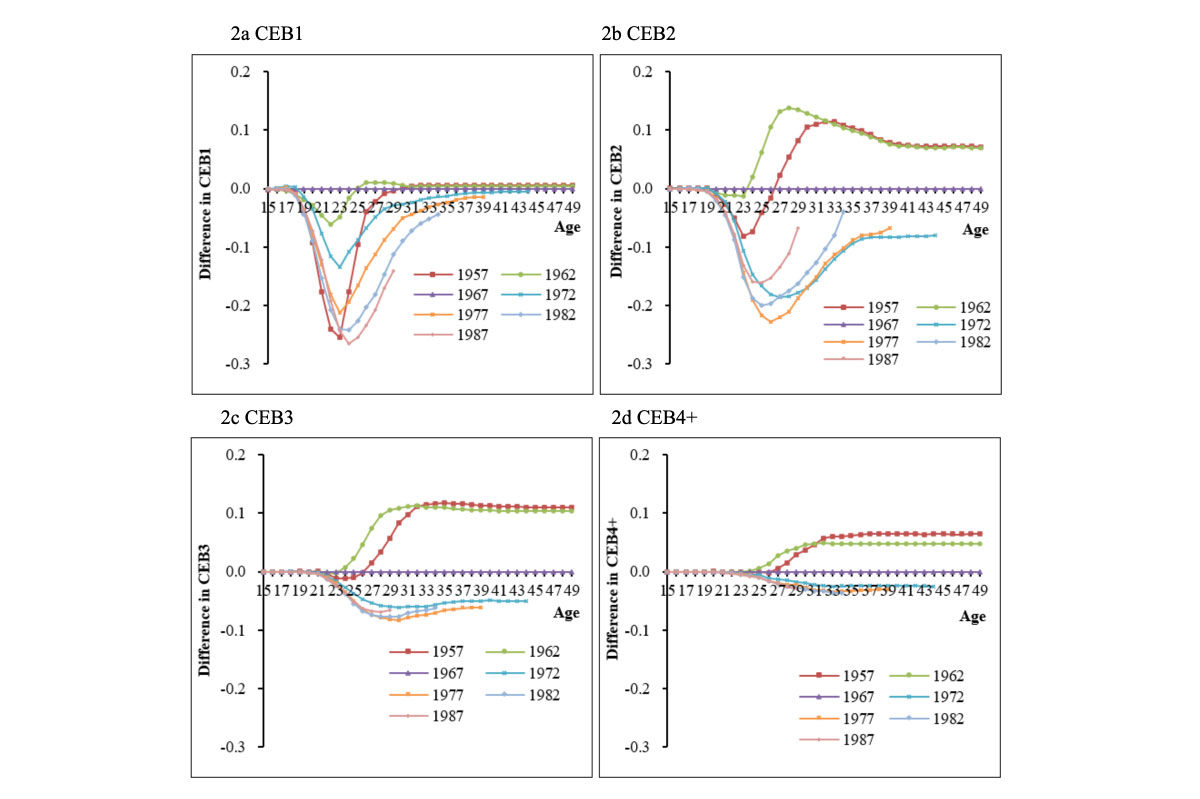
Note: Panels 2a–2d show differences in age-specific average number of CEB relative to the 1967 cohort for first, second, third, and fourth or higher-order births, respectively.
Source: Wang and Jiang (2026).
A second and increasingly important driver is shifts in women’s urban–rural and educational composition. Figure 3 shows how profoundly the 1957, 1977, and 1987 cohorts differ from the 1967 cohort. In the 1957 cohort, the higher number of CEB compared to the 1967 cohort was primarily driven by differences in fertility levels across all residence/education-specific groups. In contrast, the decline in CEB among later cohorts was more strongly influenced by changes in urban–rural population structure and educational composition. The effect of increasing education on reducing CEB has strengthened across cohorts, becoming an increasingly important part of the overall decline.
Figure 3: Decomposition of the changes in cohort average number of CEB (relative to the 1967 birth cohort)
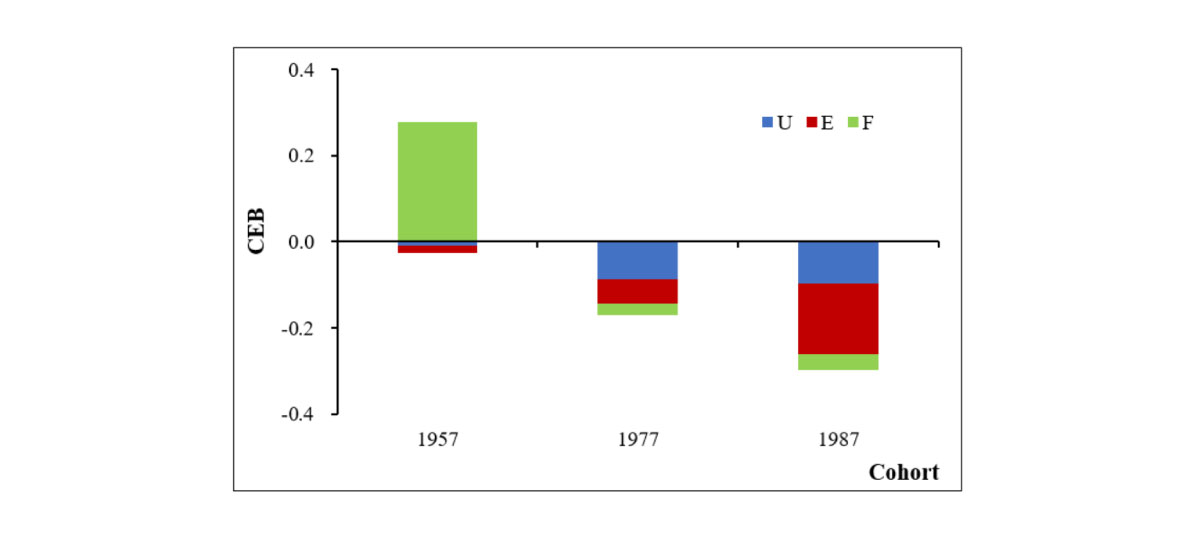
Note: Each bar shows changes relative to the 1967 cohort. U, E, and F represent the effects of changes in women’s urban-rural population structure, residence-specific educational structure, and fertility behavior within groups, respectively.
Source: Wang and Jiang (2026).
Policy implications
The fact that first-birth progression is the main driver of cohort fertility decline suggests that policies may be more effective if they target the transition to a first birth, rather than focusing primarily on higher-order births. The results of this study indicate that this transition has become increasingly difficult among urban and more educated women, for whom childlessness at younger ages has risen markedly. Policies that reduce the direct and opportunity costs of a first child are therefore more likely to address the constraints faced by this group. For rural and less educated women, by contrast, the sharper decline in CEB points to a different set of constraints around continuing childbearing.
The differences across urban–rural and educational groups highlight the need to consider social and structural factors in policies aimed at supporting fertility. Policies that assume a uniform set of barriers across all women are unlikely to be effective. Differentiated approaches are more likely to address the specific constraints faced by different groups.
References
Beaujouan, E., Zeman, K., and Nathan, M. 2023. Delayed first births and completed fertility across the 1940–1969 birth cohorts. Demographic Research 48(15): 387–420. doi:10.4054/DemRes.2023.48.15
Hwang, J. 2023. Later, fewer, none? Recent trends in cohort fertility in South Korea.
Demography 60(2): 563–582. doi:10.1215/00703370-10585316
Wang, T. and Jiang, Q.B. 2026. Trends in cohort fertility among Chinese women. Demographic Research 55(13), 413–430. doi: 10.4054/DemRes.2026.55.13