


Yingyi Lin, Emily Smith-Greenaway, Camila Cortes Rodriguez, and Shelley Clark examine how the death of a premaritally born child affects an unmarried mother’s future life trajectory in 26 sub-Saharan Africa countries. They find that the loss of a child tends to accelerate marriage entry for unwed mothers, but often under disadvantaged circumstances.
In many parts of the globe, having a child as an unmarried woman comes with a host of social and economic challenges, and can affect the timing and the quality of a woman’s eventual marriage (Smith-Greenaway and Clark 2018; Smith-Greenaway, Koski, and Clark 2021). Despite focusing on high-mortality contexts, like contemporary Africa, research on this question often makes a rather heroic assumption: that the out-of-wedlock child survives. In reality, however, child mortality remains high in Africa (Smith-Greenaway et al. 2021), and children born outside marriage are especially vulnerable to premature death (Clark and Hamplová 2013).
What happens when an unwed mother’s child dies?
This raises the question of whether a child’s survival alters unmarried mothers’ lives, including their eventual entry into marriage. How does the death of a premaritally born child affect the mother’s future marital outcomes? Does the child’s death deepen any observed disadvantage or can it “remove” the stigmatizing status of single motherhood, and improve her chances of marrying? Alternatively, given the high frequency of child fostering in Africa (Cotton 2021), are unwed mothers’ life trajectories unaffected by the loss of a child?
In a recent paper, we tested these competing hypotheses by examining unmarried mothers’ subsequent marital trajectories after a first birth as a function of their child’s survival (Lin et al. 2025). We used the most recent round of Demographic and Health Surveys, collected between 2011 and 2023, spanning 26 countries in sub-Saharan Africa. On average, 17% of women of reproductive age (15–49) across these countries experienced a premarital birth, yielding a study sample of 69,800 women. Among them, 3% experienced the death of their firstborn during infancy, allowing us to assess how marital timing and union quality differ between women whose premaritally born child died and those whose child survived.
Premarital child loss and mothers’ marital outcomes
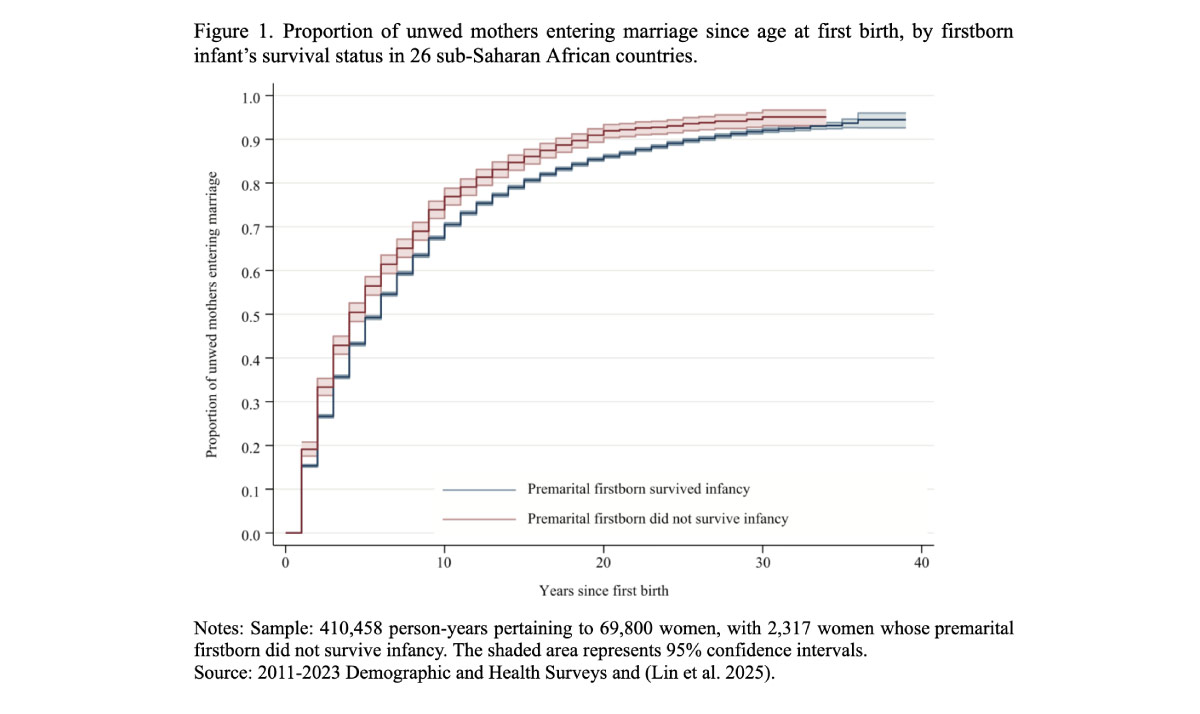
Unwed mothers whose first child died during infancy marry sooner relative to their unmarried counterparts whose first child survived (Figure 1). This pattern persists after controlling for mothers’ socioeconomic characteristics, including education. However, these analyses offer no qualitative distinctions as to the nature of these women’s marital unions , a topic that has been largely overlooked in the literature.
Closer scrutiny reveals that following their child’s death, women tend to marry partners with 0.3 fewer years of schooling, are 16% more likely to enter polygynous unions, and 26% more likely to experience domestic violence.
As child mortality declines, do these patterns change?
While the broader question concerns women’s marital trajectories following child loss, a natural follow-up is whether these patterns persist as deaths, including child deaths, become rarer over time.
In our main analyses, we focused on all reproductive-age women in the Demographic and Health Surveys. These include women born in different cohorts who have navigated romantic relationships, childbearing, and marriage under distinct circumstances. As such, we analyzed whether our findings varied across birth cohorts—including women born in the 1970s (or earlier), 1980s, or 1990s (or later).
We found that inequalities in both marital timing and quality between unmarried mothers by children’s vital status are largest for the youngest cohort in our data, the cohort with the lowest rates of child mortality. Specifically, experiencing an infant death is associated with substantially faster entry into marriage among women born in or after the 1990s, compared to those born in or before the 1980s (Figure 2). Moreover, the spousal educational gap between mothers whose child died versus survived is considerably larger among women born in the 1980s and 1990s than among those born in or before the 1970s.
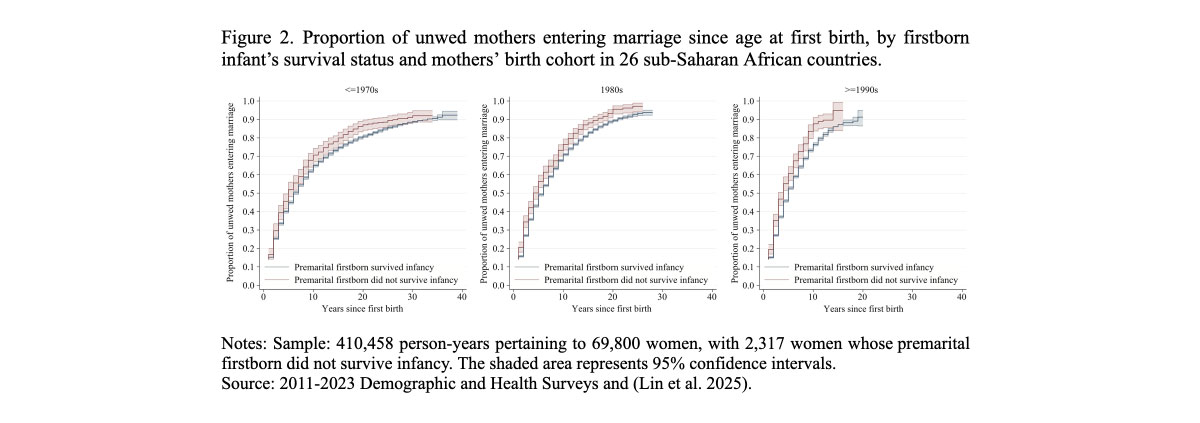
This suggests that the death of a firstborn child before marriage has become more consequential for women’s subsequent marriage outcomes, with respect to both marriage timing and quality, despite secular decreases in child mortality.
Final remarks
Our work demonstrates that a child’s death is not only an outcome of inequality but may also be a future source of disadvantage. Future research should examine more closely how child loss reshapes women’s life trajectories and highlights the unique double burden of unwed mothers who may not only bear a child outside marriage but also, in some cases, lose that child. Although child mortality has been declining in Africa, our findings suggest that it is becoming a more consequential event for women, attesting to the need to further understand the impact of child loss on women’s lives and wellbeing.
References
Clark, Shelley, and Dana Hamplová. 2013. “Single Motherhood and Child Mortality in Sub-Saharan Africa: A Life Course Perspective.” Demography 50 (5): 1521–1549. https://doi.org/10.1007/s13524-013-0220-6.
Cotton, Cassandra. 2021. “An Enduring Institution? Child Fostering in Sub-Saharan Africa.” Population and Development Review 47 (4): 1179–1206. https://doi.org/10.1111/padr.12439.
Lin, Yingyi, Emily Smith-Greenaway, Camila Cortes Rodriguez, and Shelley Clark. 2025. “From Birth to Death: The Marital Consequences of Child Loss for Unmarried Mothers.” Studies in Family Planning. Advance online publication. https://doi.org/10.1111/sifp.70041
Smith-Greenaway, Emily, Diego Alburez-Gutierrez, Jenny Trinitapoli, and Emilio Zagheni. 2021. “Global Burden of Maternal Bereavement: Indicators of the Cumulative Prevalence of Child Loss.” BMJ Global Health 6: e004837. https://doi.org/10.1136/bmjgh-2020-004837.
Smith-Greenaway, Emily, and Shelley Clark. 2018. “Women’s Marriage Behavior following a Premarital Birth in Sub-Saharan Africa.” Journal of Marriage and Family, 80(1): 256–270. https://doi.org/10.1111/jomf.12433.
Smith-Greenaway, Emily, Alissa Koski, and Shelley Clark. 2021. “Women’s Marital Experiences Following Premarital Fertility in Sub-Saharan Africa.” Journal of Marriage and Family 83 (2): 394–408. https://doi.org/10.1111/jomf.12704.