
Beyond the “demographic winter”
In Italy, as elsewhere, population ageing seems destined to create a series of daunting difficulties. However, as the new e-book edited by Daniele Vignoli and Gustavo De Santis shows, with … Read more
This qualitative study explores solitary ageing in Ghana’s Greater Accra Region. Interviews with 52 older adults from six communities revealed situations of emotional isolation, social disconnection, and poverty. Andrew Kweku … Read more
Lifespan is uncertain, even for well-informed individuals. Sha Jiang, Wenyun Zuo, Zhen Guo and Shripad Tuljapurkar show that this irreducible demographic risk increases with delayed pension claiming and hits male … Read more
The gradual increase in life expectancy and the accelerating pace of population aging pose significant challenges to economies, health systems, and healthcare infrastructure all over the world and, as Yu … Read more
Pay-as-you-go (PAYGO) pension systems are problematic: commitments are meant to be long term, but reality changes rapidly, which forces a frequent revision of rules. Gustavo De Santis suggests an alternative … Read more
The implications of inaccurate age-reporting among older people are rarely investigated. Alice Reid, Allen Kabagenyi, Stephen Wandera, Joshua Beinomugisha and Sarah Walters suggest that age-heaping may have more to do … Read more
Rapid population aging may undermine the viability of the German pension system. Is working longer a remedy? Christian Dudel, Elke Loichinger, Sebastian Klüsener, Harun Sulak, Mikko Myrskylä analyse what is … Read more

Does health deterioration manifest at increasingly (dis)similar ages? Iñaki Permanyer, Francisco Villavicencio and Sergi Trias-Llimós explore inequalities in age-at-morbidity onset globally, and find these to be larger than lifespan inequalities. … Read more
Feelings of loneliness are not very widespread among European older adults (aged 50 years and over) according to SHARE data. And, surprisingly enough, according to the analysis of Omar Paccagnella, … Read more
Longevity Blue Zones are regions of the world where the population has exceptional longevity. Until recently, four of them had been identified: the Nicoya peninsula in Costa Rica, and three … Read more
The pre-COVID literature established that lacking a partner or children was among the risk factors for loneliness among older people. Bruno Arpino, Christine A. Mair, Nekehia T. Quashie, and Radoslaw … Read more
Population aging is contributing to an increase in loneliness around the world. Lauren Newmyer, Ashton M. Verdery, Haowei Wang, and Rachel Margolis explore loneliness among late-middle-aged and older adults and … Read more
India’s economic sector faces a reckoning with its ageing population. Aparajita Chattopadhyay and David E. Bloom‘s analysis, based on the Longitudinal Aging Study in India (LASI), indicates that health is … Read more

Benedetta Scotti1 examines the relationship between late-career trajectories and post-retirement mortality in Italy. She finds that exposure to employment instability in later working life, an increasingly prevalent phenomenon in many … Read more
Ageing occupies the forefront of the social and economic policy debate in the European Union (EU). However, ageing patterns differ considerably across EU territories because of distinctive demographic and spatial … Read more
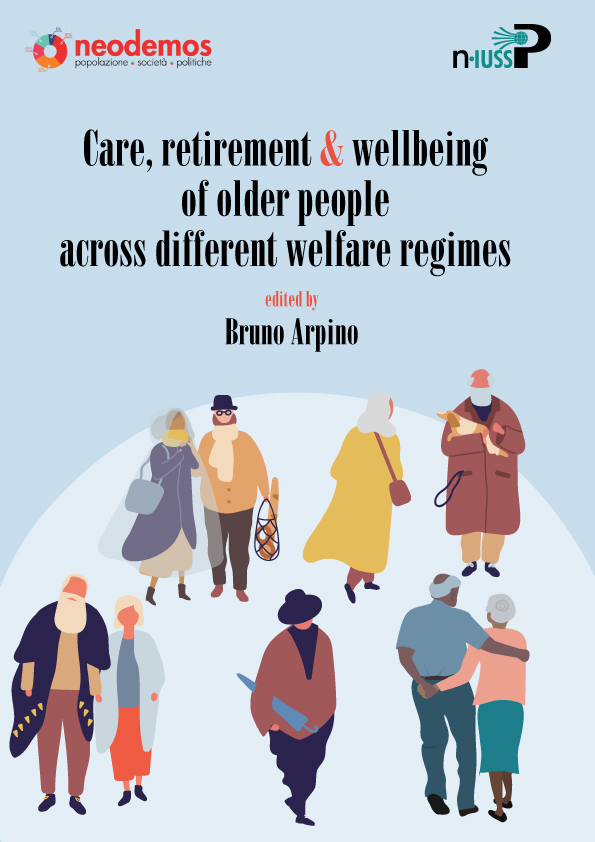
Bruno Arpino edits the first N-IUSSP e-book, reporting the main results of an international research project that has just come to an end: “Care, retirement & wellbeing of older people … Read more
A strong positive association exists between children’s education and parental health in India. Berenike Thoma and Jan-Walter De Neve explain that this positive relationship persists when controlling for a wide … Read more
Around the world, more and more people age without close kin. Contrary to expectations, however, according to Małgorzata Mikucka, this does not reduce their life satisfaction, or at least not … Read more
Does the impact of socioeconomic factors on health after midlife vary among women and men depending on the welfare context? Apparently it does: Damiano Uccheddu, Anne H. Gauthier, Nardi Steverink, … Read more
Depression is one of the most common mental disorders in later life. Omar Paccagnella suggests a new approach to classify older individuals into distinct subgroups, based on different combinations of … Read more
Małgorzata Mikucka sheds new light on the loneliness of elderly people in Poland, focusing on the events and transitions that trigger this feeling. Weak social ties and a legacy of … Read more
Health deteriorates with age, and it can be further worsened by adversities experienced during early adulthood and middle age. On SHARE data, Francesca Zanasi, Gustavo De Santis and Elena Pirani measure … Read more
Giorgio Di Gessa, Paola Zaninotto and Karen Glaser find that, in England, most grandmothers and grandfathers provide grandchild care throughout the year to allow parents to undertake paid work. However, … Read more
As children are often the main source of support in later life, childless older adults are presumed to have higher risks of poor health compared to parents. Nekehia T. Quashie, … Read more
Individual support for democracy in the population is essential for the stability of democracies. However, not much is known about how demographic change, such as population aging, affects attitudes in … Read more
Aïda Solé-Auró and Mariona Lozano present data on “satisfied life expectancy” by gender and educational level in Spain. One of their somewhat paradoxical findings is that even though Spaniards are … Read more
Life expectancy at birth is widely employed to measure longevity. However, as José Manuel Aburto, Ginevra Floridi and Ella Fegitz argue, another complementary dimension of great relevance in health research … Read more
Some older adults do not have spouses or biological children, i.e. the types of family members who are most likely to provide help in case of need. Rachel Margolis and … Read more
Population ageing is inevitable, but its negative consequences on the future labour force of the European Union, up to 2060, could be greatly attenuated if women and immigrants were more … Read more
One way to tackle population ageing and its negative consequences on pension systems is to increase the official retirement age. However, most employees retire earlier than “expected”. Jana Mäcken tests the … Read more
While the mean ages at death for Danish and Swedish centenarians were relatively constant at around 102 years for the cohorts born between 1870 and 1904, Anthony Medford shows that … Read more
Official demographic forecasts have always been too timid about future increases in life expectancy, and according to Nico Keilman, continue to be so even today. There are reasons for this … Read more
Declining fertility and increasing migration are contributing to growing shares of older Thais who will age with few children, or none at all, or whose children live far away.Quashie and … Read more
Surprising as it may seem, even in developed countries, systematic and large differences in survival exist between rich and poor populations. In France, for instance, Nathalie Blanpain tells us that … Read more
Previous research has indicated that being born to older parents is detrimental for offspring longevity. However, the secular trend of increasing longevity may moderate or even reverse any potential negative … Read more
The negative association between advanced maternal age and low birth weight has become progressively weaker over time in the UK (between 1958-2001). This pattern, as Alice Goisis explains, is partly … Read more
In North America, grandparents live for longer now than in the past, and spend more years in good health, despite being older. However, Rachel Margolis and Laura Wright also find … Read more
Christian Dudel and Mikko Myrskylä study how the length of working life has developed in the U.S. since the early 1990s. While overall life expectancy has increased, there has been … Read more
“Summertime, and the livin’ is easy” — so begins one of the most famous American songs, Summertime from the Gershwin brothers’ Porgy and Bess. Is the living really easier in … Read more
In most Western European countries, retiring and entering grandparenthood are relatively parallel events for most individuals, with grandparenthood often occurring a few years before retirement (Leopold and Lechner, 2015).Does being … Read more
As America’s population ages, the number of Americans with dementia is increasing. Because people with dementia often need help with activities of daily living, the cost of caring for a … Read more
Europe has large projected increases in the proportion of older people in the population (United Nations 2013). Therefore, high quality, representative longitudinal data on the older European population are essential … Read more
Paid work in adulthood is generally considered beneficial for physical and psychological health and well-being (Woodell and Burton 2006) but its effects at older ages are unclear. Research on work … Read more
Ongoing increases in life expectancies may slow the growth of living standards in developed countries. One reason for this is that reductions in mortality rates, which these days are generally … Read more
The emergence of large numbers of centenarians has accompanied the ageing of our populations. The number of people aged 100 years and over in England and Wales, for example, increased … Read more
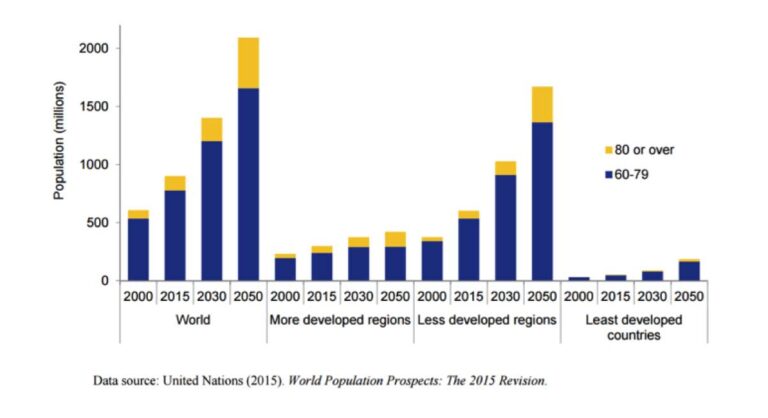
Two thirds of the world’s older persons live in the developing regions and their numbers are growing faster there than in the developed regions. World Population Ageing Report
Why do we need better data on older people? To accurately understand population change – its scale, speed, determinants and variants – we need accurate data on the age of … Read more
Europe’s population is bound to shrink before 2050: according to the latest revision (2015, medium variant) of the UN (2015) projections, it will decline by 4.5% (31 million) between 2015 … Read more
Loneliness is widely perceived as a problem of old age, as part of “normal” aging. Research shows, however, that only 5 to 15% of adults aged 60–80 report frequent feelings … Read more
In countries with high life expectancies, death is predominantly the consequence of cancers and diseases of the circulatory system. Yet, infectious diseases have not disappeared from public health concerns, and … Read more
Pay-as-you-go (PAYG) pension systems are frequent in OECD countries, usually in combination with some form of funding (OECD 2014, 2015), and they have been very extensively studied. But their reputation … Read more

The idea of a static measure of age is changing (Christensen et al., 2009; Sanderson & Scherbov, 2013). The concept of ageing is not independent of time and place, and … Read more

Si Jeanne Calment a vécu un peu plus de 122 ans et que rien n’indique clairement que ce record mondial soit une limite infranchissable, il est fort probable qu’une telle … Read more

La doyenne de l’humanité, la française Jeanne Calment est décédée en 1997 à 122 ans et 5 mois. Bien que dûment vérifié et homologué par le groupe international de recherche … Read more